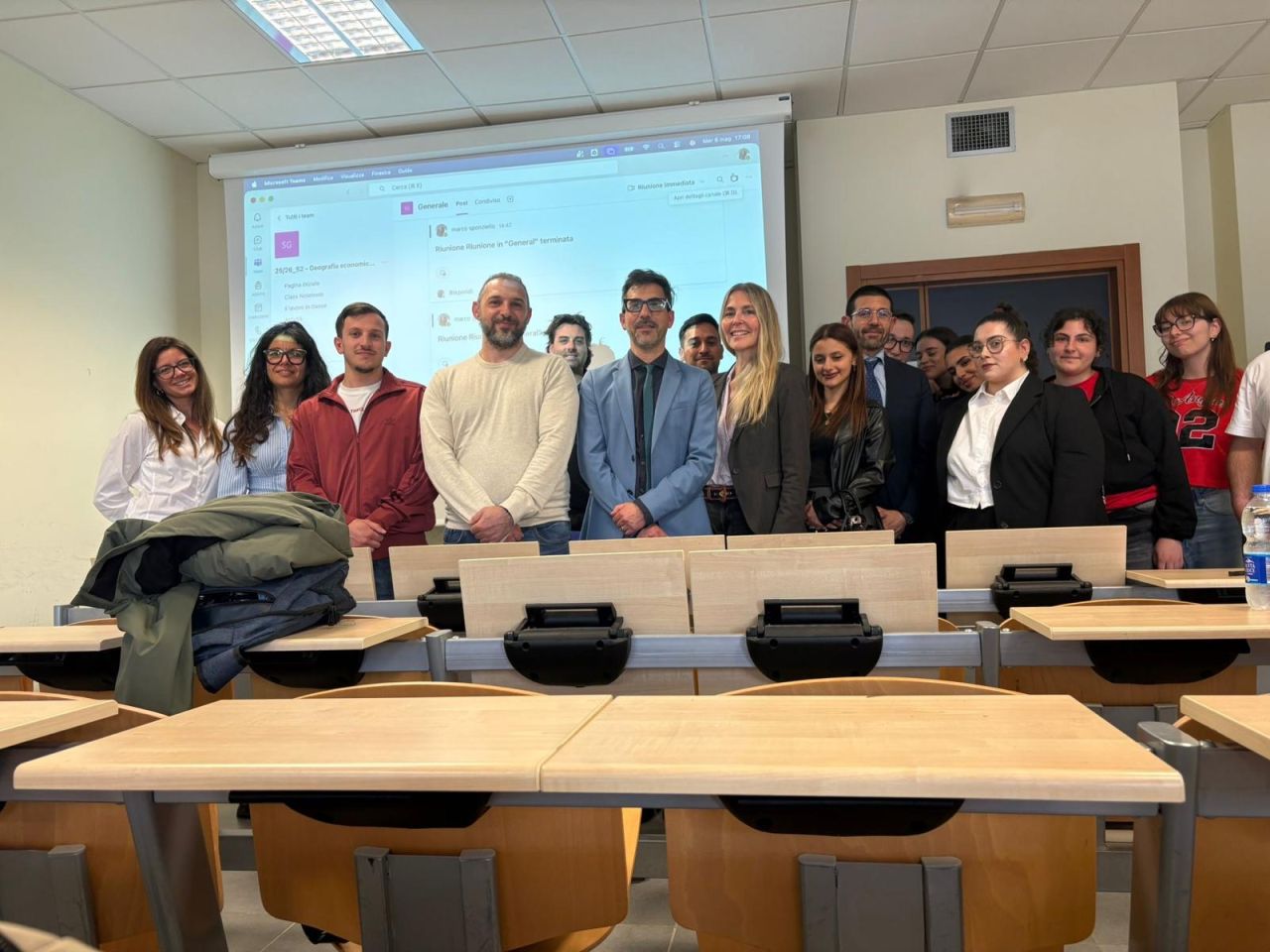
On May 6th, 2026, we took part in an interesting discussion on the future of relations between Europe and Africa.
Organized within the framework of the Sustainable Development Festival promoted by ASviS (Italian Agency for the Sustainable Development), the seminar “Strategic Italy-Africa Plan, Carbon Market and Territorial ESG for Euro-Mediterranean Sustainable Development” brought together academics, professionals, and innovators to define the new coordinates of susta inability.
The event took place at the Ecotekne University Campus in Lecce and was integrated into the Master’s Degree course in Euro-Mediterranean Governance of Migration Policies, underscoring the vital link between geopolitical stability and economic development.
Presided over and introduced by the President of the course, Prof. Ubaldo Villani-Lubelli, the meeting highlighted how the Mediterranean must transition from being perceived as a frontier to becoming a bridge for “peer-to-peer” cooperation, reflecting the core spirit of the Mattei Plan.
Territorial ESG and Carbon Markets: Beyond Compliance
Prof. Marco Sponziello (President of Next EU and European Climate Pact Ambassador) emphasized the measurability of sustainability.
The key proposal was the adoption of Territorial ESG: specific metrics that enable public administrations and local regions to attract responsible investment by demonstrating transparency and tangible impact.
In this context, the Carbon Market emerges as a strategic financial tool for decarbonization. The discussion featured several high-level technical contributions:
- Prof. Massimiliano Montini (University of Siena): Addressed the European legal framework required to provide stability and trust in the credit market.
- Dr. Flavia Di Pilla (International Lawyer): Explored the global dimension of environmental credits and the legal dialogue between different jurisdictions (Siena and OAB DF).
- Dr. Simone Chiaritti (Olivami ETS): Presented a successful case study from Salento, where the regeneration of olive groves devastated by Xylella has been transformed into a certified reforestation model capable of generating carbon credits.
The importance of storytelling
In the end, the journalist Paola Moscardino highlighted the role of public language in spreading a culture of sustainability. In a historical phase where themes such as carbon markets, environmental credits, ESG, and ecological transition are crucial for the future of each of us, they need to be diffused with clarity and narrative quality in order to engage citizens, businesses, institutions, and the younger generations.
Without narration, there is a risk that investments in a territory remain purely economic, lacking a social root. And if that territory is not narrated, it is not truly participating in the development project.
The ecological transition is not merely an environmental challenge but a significant opportunity for industrial and social growth. It requires a new set of multidisciplinary skills and a commitment to an authentic storytelling, far from a greenwashing approach.