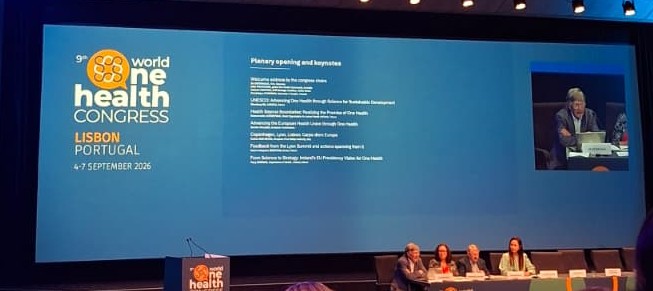
Last week we participated in the 9th World One Health Congress (9WOHC) in Lisbon, Portugal – a major global gathering dedicated to integrated human, animal, and environmental health approaches.
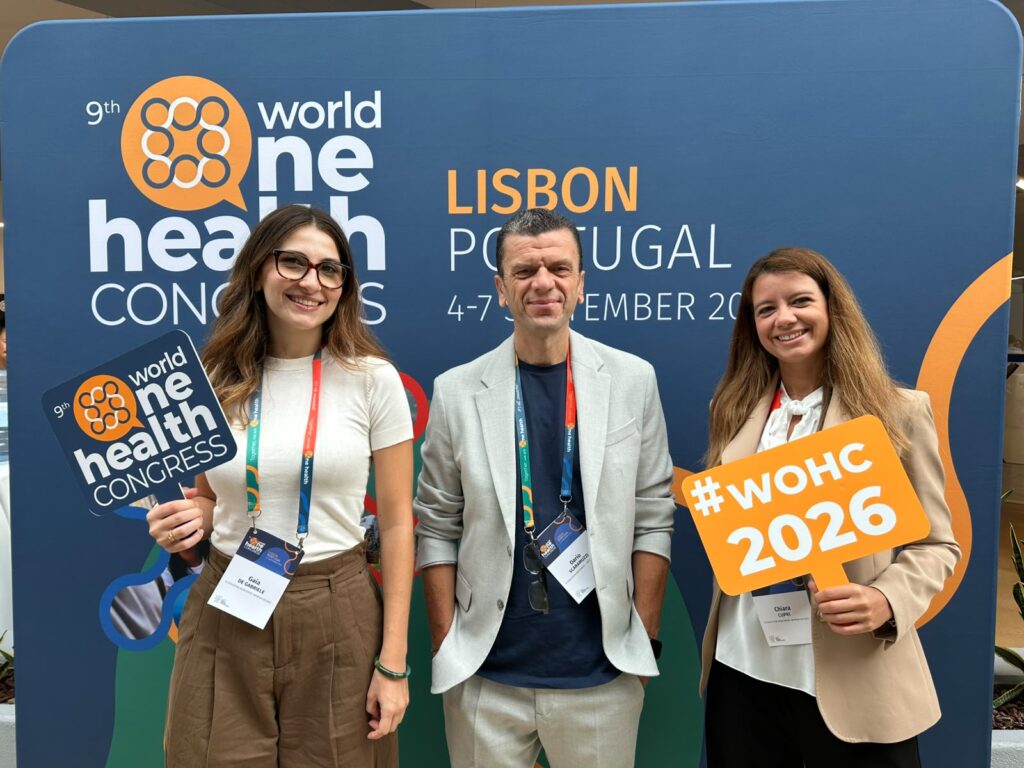
Our team was represented by Director Dr. Dario Scaramuzzi alongside Scientific Project Coordinators Chiara Cupri and Gaia De Gabriele, who presented a scientific poster for the MPOX-PROBE project. Meanwhile, our partner Anthony Nyerere, a PhD student from the Sokoine University of Agriculture, delivered an oral presentation for the NeuroSolve project.
Both projects are deeply rooted in and inspired by the One Health approach, addressing complex health challenges at the intersection of human, animal, and environmental well-being.
MPOX-PROBE: Integrated Mpox surveillance along the Congo River
Our poster highlighted the MPOX-PROBE project, aimed at strengthening epidemiological, genomic, environmental, and community surveillance of the Mpox virus (MPXV) along the border river area between the Democratic Republic of the Congo (DRC) and the Republic of the Congo (RoC).
Key highlights presented:
- One Health Approach: Combining KAP surveys, qualitative interviews, and quantitative questionnaires with spatiotemporal risk and transmission modeling.
- Innovative Diagnostics & Environmental Surveillance: Utilizing hospital air sampling alongside rapid point-of-care molecular assays to detect Mpox clade I directly in field settings.
- Community Engagement: Addressing risk communication and stigma reduction, supported by strong local willingness to accept vaccination (56.3%).
Neurosolve: “The Wealth Paradox” in behavioral sustainability for Taenia solium prevention
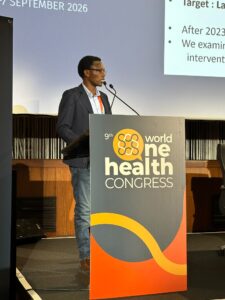
Representing Neurosolve, A. Nyerere (SUA) talked about “The Wealth Paradox: Survival Analysis of Behavioral Sustainability in Taenia solium Preventive Practices, Tanzania.”
Analyzing longitudinal data from 521 households across Kongwa and Songwe Districts (Tanzania), the study evaluated the long-term sustainability of preventive behaviors against neurocysticercosis: latrine use, pig confinement, and household water treatment.
Key takeaways:
- Early Discontinuation & Cycling: Sustainability is non-linear; 58% of practice lapses occurred within the first two years, and 23% of households cycled between adopting and abandoning practices.
- The Wealth Paradox: Factors driving initial adoption do not ensure long-term maintenance. Wealthier households adopted pig confinement faster but were 35% more likely to discontinue the practice over time.
- Implementation Science Focus: Cross-sectional data can overestimate sustained behavior. Future interventions must target behavioral durability and phase-specific determinants to ensure equitable health impact.
Want to know more about our projects? Don’t hesitate to reach us → info.revolutionworldwide@gmail.com