The Initiative
The WOLVAX-DENGAFRICA proposal has been officially submitted under the call HORIZON-JU-GH-EDCTP3-2026-02-two-stage Global collaboration action on climate and health in sub-Saharan Africa. The core objective of this initiative is to evaluate innovative strategies to prevent the growing impact of dengue across West Africa.
The Context: A Rising Health Threat
Dengue is increasingly reported throughout sub-Saharan Africa, with repeated epidemics hitting countries such as Burkina Faso, Senegal, and Mali, where the virus has become one of the most frequently detected arboviruses. Despite this growing threat, evidence-based prevention strategies adapted to African settings remain limited, particularly within climate-sensitive transmission contexts.
The Strategy: Vector Control and Vaccination
WOLVAX-DENGAFRICA proposes a pragmatic, climate-informed programme that combines next-generation vector control with targeted vaccination:
-
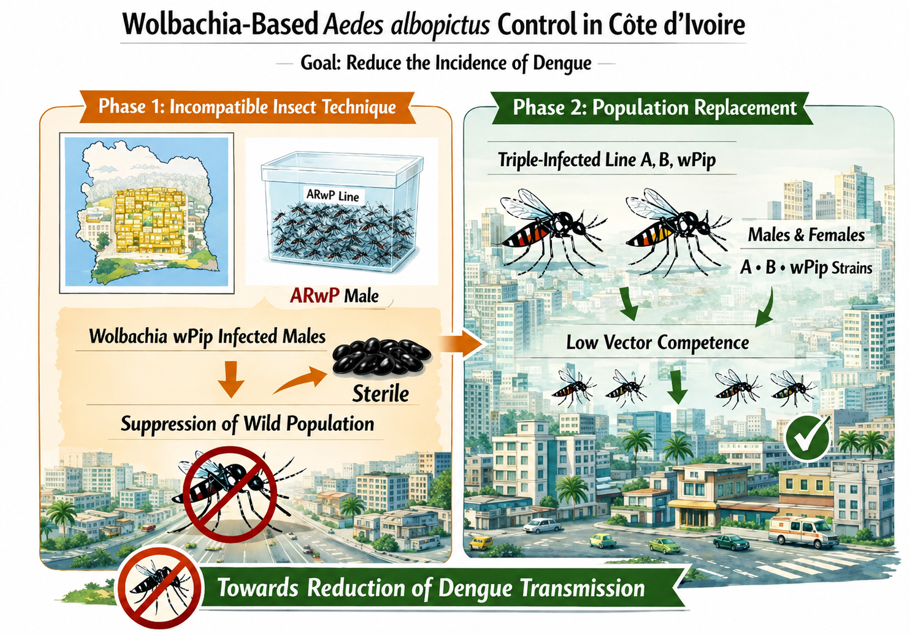
Vector Control (Côte d’Ivoire): The project will implement a Wolbachia-based vector control strategy targeting Aedes albopictus, an invasive mosquito species responsible for dengue transmission in both Africa and Europe.
-
Clinical Trial (Côte d’Ivoire, Burkina Faso, and Mali): In parallel, a phase 2b clinical trial will evaluate a live attenuated dengue vaccine candidate. This study will focus specifically on safety, immunogenicity, and the feasibility of simplified vaccination schedules, including for vulnerable populations such as individuals with sickle cell disease.
A Strong International Consortium
The project is coordinated by Aix-Marseille Université and brings together a multidisciplinary network of European and African institutions. The consortium unites leading expertise in arbovirology, vaccination, vector control, clinical research, and public health implementation, featuring collaboration among Université de Bordeaux, Institut Pasteur, INSERM, ENEA, Centro Agricoltura e Ambiente Giorgio Nicoli, R-Evolution Worldwide, Institut National de Santé Publique, Association PAC-CI, and Institut Pasteur de Côte d’Ivoire.
Expected Impact
The insights gained from this project are expected to actively support future policy recommendations and significantly strengthen preparedness for dengue emergence in sub-Saharan Africa under rapidly changing climate conditions.